
Top 5 Cloud Security Risks in 2026
Top 5 Cloud Security Risks in 2026 (and How to Protect Your Hybrid Cloud)
Most companies no longer keep everything in one place. Some data sits on their own servers. Some live in a private cloud. The rest runs on public platforms like AWS, Microsoft Azure, or Google Cloud.
This mix is called a hybrid cloud. It gives you flexibility, but it also gives attackers more places to look for weak spots.
In this guide, we will walk through the top cloud security risks in 2026 in plain language. For each one, you will get simple steps you can start using right away. You do not need to be a security expert to follow along.
In this article:
- Why hybrid cloud security is hard
- The 5 biggest cloud security risks
- A simple security plan you can follow
- A quick checklist
- FAQs
What Is Hybrid Cloud Security?
Hybrid cloud security risk means protecting the data, apps, and users that move between you on-premises systems, private cloud, and public cloud. The goal is simple: keep the same level of protection everywhere, so attackers cannot slip in through the weakest link.
Why Is Hybrid Cloud Security So Hard?
Every platform has its own settings, rules, and tools. When you use several immediately, things get untidy. Here is where most teams struggle:
- Rules do not match. One platform is locked down tight while another is wide open.
- Poor visibility. Teams cannot always see where data is going.
- Confusion about who is responsible. Many people think the cloud provider handles everything. It does not.
- Speed over safety. New apps go live faster than security can review them.
- Not enough skilled people. Cloud security is a specialized skill, and good talent is hard to find.
These gaps are exactly what attackers look for. Now let us look at the five biggest cloud security risks.
1. Cloud Misconfiguration
A cloud misconfiguration simply means leaving the digital front door unlocked. It happens when cloud storage or security settings aren’t set up properly such as granting everyone access by mistake or leaving storage buckets wide open to the public. Hackers rarely need to “crack” complex defenses when a simple setup error lets them walk right in and access sensitive data.
Common examples:
- Storage buckets accidentally set to “public”
- Default passwords that were never changed
- Remote access ports (like RDP or SSH) open to everyone
- Logging or encryption switched off
How to fix it:
- Use a CSPM tool. Cloud Security Posture Management (CSPM) software scans your accounts all day and flags risky settings.
- Scan your code before it goes live. If you use Infrastructure as Code (like Terraform), check it for mistakes before deploying.
- Set a standard. Use trusted guides like the CIS Benchmarks so every team follows the same rules.
- Check regularly. Run automated audits instead of waiting for a yearly review.
2. Weak Identity and Access Management (IAM)
What it is: Poor control over who can log in and what actions they can perform.
Today, attackers rarely need to “hack” their way in—they simply log in using stolen credentials. If a single account has excessive permissions, one compromised password can expose your entire infrastructure.
Warning signs:
- Team members hold admin privileges they do not need.
- Accounts belonging to former employees remain active.
- Passwords and API keys are hardcoded directly into source code.
- Critical accounts lack multi-factor authentication (MFA).
How to fix it:
- Enforce least privilege: Grant users access only to the resources essential for their daily roles.
- Enable phishing-resistant MFA: Implement passkeys or physical hardware keys, which offer far greater protection than SMS verification codes.
- Adopt a Zero Trust model: Operate on the principle of “never trust, always verify.” Authenticate and validate every user, session, and device continuously.
- Use a dedicated secrets manager: Store API keys and credentials in encrypted secrets managers, never in plain-text spreadsheets or configuration files.
- Conduct quarterly access audits: Regularly review permissions and revoke access that is no longer necessary.
- Secure non-human identities: Manage service accounts, bots, and automated pipelines with the same security rigor applied to human users.
3. AI-Powered Cyberattacks
What it is: Threats amplified by artificial intelligence to execute attacks faster, automate vulnerability discovery, and deceive targets with high precision.
Attackers now leverage AI to craft hyper-realistic phishing emails, uncover system flaws rapidly, and generate deepfake audio or video impersonations of leadership. An employee receiving an urgent, realistic voice memo can easily be tricked into approving an unauthorized wire transfer.
At the same time, internal adoption of AI introduces risk: teams may inadvertently feed proprietary data into public models or deploy unsecured machine-learning endpoints.
How to fix it:
- Deploy behavior-based analytics: Modern SIEM and XDR platforms analyze activity patterns to detect anomalies before damage occurs.
- Establish out-of-band verification: Require employees to confirm high-risk requests (such as fund transfers or credential updates) via a secondary, trusted communication channel.
- Define clear AI governance: Publish explicit guidelines detailing which AI tools are approved and what proprietary data must never be uploaded.
- Harden internal AI infrastructure: Restrict access to training datasets, custom model weights, and inference APIs.
- Run adaptive phishing simulations: Train staff using modern, realistic scenarios reflecting current AI-driven deceptive techniques.
4. Insecure APIs and Supply Chain Risks
What it is: Vulnerabilities embedded within third-party integrations, external software libraries, and API communication channels.
APIs allow disparate services to exchange data, but every unmonitored endpoint functions as a potential point of entry. Furthermore, relying on third-party code or SaaS vendors means inheriting their security weaknesses; if a software vendor is compromised, your environment can suffer downstream impact regardless of your internal controls.
Common problems:
- Endpoints lacking proper authentication, authorization, or rate limiting.
- APIs returning excessive data payloads beyond what the client requires.
- Uncataloged “shadow APIs” maintained outside the security team’s oversight.
- Unpatched, outdated third-party dependencies and open-source libraries.
- Vendor accounts configured with broad administrative access.
How to fix it:
- Maintain an API inventory: Continuously discover and catalog all endpoints, promptly deprecating unused or legacy interfaces.
- Implement modern authentication: Enforce robust standards, such as OAuth 2.0 and OpenID Connect, across all communication layers.
- Deploy an API gateway: Centralize request routing, traffic inspection, rate limiting, and access policies.
- Track software dependencies via SBOM: Maintain a complete Software Bill of Materials to identify vulnerable nested libraries quickly.
- Enforce third-party risk management: Vet every vendor’s security posture before onboarding, conduct regular reassessments, and restrict their network permissions strictly to what is required.
5. Ransomware and Data Breaches
What it is: Destructive malware campaigns designed to exfiltrate proprietary records and encrypt critical storage volumes for extortion.
Modern operations routinely practice double extortion: adversaries first extract sensitive intellectual property, encrypt primary data stores, and then demand ransom payments under threat of public disclosure. In hybrid architectures, attackers frequently exploit trusted site-to-site tunnels to traverse between on-premises servers and cloud environments while actively hunting down backup repositories to prevent restoration.
How to fix it:
- Apply the 3-2-1-1 backup strategy: Retain 3 copies of your data across 2 different media formats, with 1 copy held off-site and 1 copy stored in an immutable, air-gapped state.
- Enforce write-once immutability: Configure backup storage targets with retention locks so malicious actors cannot alter or purge snapshot archives.
- Segment network environments: Isolate critical workloads via micro-segmentation to halt lateral movement during an active intrusion.
- Encrypt ubiquitous data flows: Apply strong encryption standards to all assets both at rest and in transit across networks.
- Test disaster recovery workflows: Conduct scheduled tabletop exercises and recovery simulations at least once a year.
- Roll out Endpoint Detection and Response (EDR): Maintain continuous telemetry and endpoint protection across servers, ephemeral cloud workloads, and container runtimes.
A 7-Step Roadmap to Secure Your Hybrid Cloud
Systemic security is built incrementally. Prioritize implementation in this sequence:
- Clarify the Shared Responsibility Model: Cloud infrastructure providers secure the underlying hardware and virtualization layer; you remain responsible for securing your identities, data, network traffic, and application code.
- Establish Centralized Visibility: Ingest telemetry, access events, and infrastructure logs into a centralized dashboard to eliminate blind spots across all cloud and local environments.
- Execute Zero Trust Architecture: Enforce continuous identity validation and isolate resources into small micro-segments to prevent breach escalation.
- Automate Continuous Guardrails: Embed static and dynamic security assessments directly into your CI/CD delivery pipelines (DevSecOps) so misconfigurations are caught before deployment.
- Classify and Encrypt Critical Data: Inventory sensitive records, enforce encryption across all tiers, implement Data Loss Prevention (DLP), and ensure compliance with relevant regulatory standards (such as GDPR, HIPAA, PCI DSS, or India’s DPDP Act).
- Formalize and Rehearse Incident Response: Maintain explicit protocols defining escalation hierarchies, communication channels, containment steps, and regulatory notification thresholds.
- Cultivate Security Culture: Provide ongoing security awareness training that encourages teams to recognize threats and report anomalies promptly without fear of reprisal.
Hybrid Cloud Security Checklist
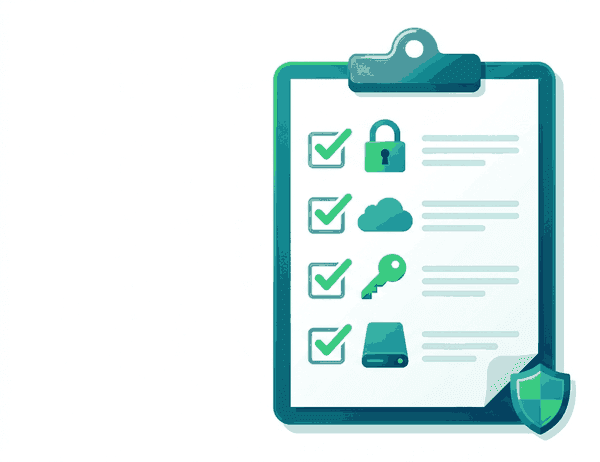
Audit your organizational readiness against these key requirements:
- ✅MFA is enforced across all administrative portals and remote access gateways.
- ✅ A Cloud Security Posture Management (CSPM) solution continuously monitors all cloud accounts.
- ✅ Role-based access permissions have been reviewed and pruned within the past 90 days.
- ✅ A comprehensive inventory of all digital assets, external APIs, and third-party vendors is active.
- ✅ Encryption is enforced for all stored data and internal/external network traffic.
- ✅ Data backups are immutable, air-gapped, and tested regularly for rapid restoration.
- ✅ Audit logging is centralized with automated real-time alert triggers configured.
- ✅ The incident response playbook has been simulated and reviewed within the past 12 months.
- ✅Automated vulnerability and compliance testing runs inside your software deployment pipeline.
- ✅ Third-party and vendor risk reviews are current and formally documented.
If you cannot verify at least seven of these controls, prioritize the top three immediately: enforcing MFA, deploying a CSPM, and completing a 90-day access audit provide the highest immediate security uplift.(Contact us Our Expert)
Frequently Asked Questions (FAQs)
What are the primary cloud security risks?
The most pressing vulnerabilities stem from configuration errors, excessive identity permissions, sophisticated AI-driven deception, unmonitored API integrations, and hybrid-focused ransomware operations.
What is the leading cause of cloud security incidents?
Human error—particularly misconfigured resource policies and compromised authentication credentials—accounts for the vast majority of incidents. Mitigating these vectors requires automated configuration guardrails and phishing-resistant multi-factor authentication.
How should an organization approach hybrid cloud security?
Begin by establishing complete asset visibility. Once your environment is cataloged, enforce strict identity policies through Zero Trust, deploy automated posture management, encrypt all critical storage volumes, and maintain verified immutable backups.
Is adopting a Zero Trust architecture mandatory?
While no single paradigm prevents every vector of compromise, Zero Trust is recognized as the standard baseline for hybrid environments because it minimizes the blast radius when an individual credential or device is compromised.
Where does provider responsibility end and customer responsibility begin?
Under the cloud shared responsibility framework, the service provider guarantees the security of the host facility, hypervisors, and core networking hardware. The customer retains full accountability for securing stored data, application logic, network access rules, and identity configurations.
How frequently should hybrid security controls be reviewed?
Operational telemetry and posture validation should occur continuously via automated tooling. User permissions and service account rights should undergo manual review every 90 days, accompanied by annual disaster recovery and incident response drills.
Conclusion
Securing modern hybrid architectures does not require defending against every conceivable threat all at once. The majority of enterprise breaches do not originate from zero-day exploits, but from foundational oversights: an open storage bucket, a weak administrative credential, an untracked API endpoint, or an untestable backup.
Address foundational hygiene first. Gain total operational visibility, implement Zero Trust principles, automate configuration checks, and foster active team awareness. Robust hybrid cloud security is not an isolated initiative—it is an enduring organizational standard.
